Hunyuan3D 2025 Progress Report: Verified Milestones and Community Growth
Author: Teddy (Invited Community Observer)
Published on: January 5, 2026
Introduction: A Community-Led Review of Hunyuan3D’s 2025
Hello everyone, I’m Teddy. As a long-time observer in the 3D AIGC space and an ordinary member of the Hunyuan3D community, it’s my great honor to join you in reviewing the solid progress this project has made in 2025. Over the past year, we’ve witnessed the rapid development of 3D AI generation technology, and Hunyuan3D has undoubtedly been one of the brightest stars. From the release of version 2.0 at the beginning of the year to the v2.5 technical report mid-year, and the increasingly active community ecosystem, Hunyuan3D has consistently brought us surprises.
It’s important to clarify that this article is not an official announcement but a community summary based on publicly available information (the official GitHub repository and arXiv papers). Our goal is to provide an objective and neutral perspective to chronicle Hunyuan3D’s real technical advancements and community growth in 2025. We aim to help every friend interested in 3D AI better understand its present and collectively look forward to its future. Let’s get started!
Part 1: Verified Milestones: The Official Hunyuan3D Timeline of 2025
2025 was a year of intensive releases and rapid iteration for Hunyuan3D. To clearly illustrate its development path, we have compiled the following timeline of key milestones based on the “News” section of its official GitHub repository [2].
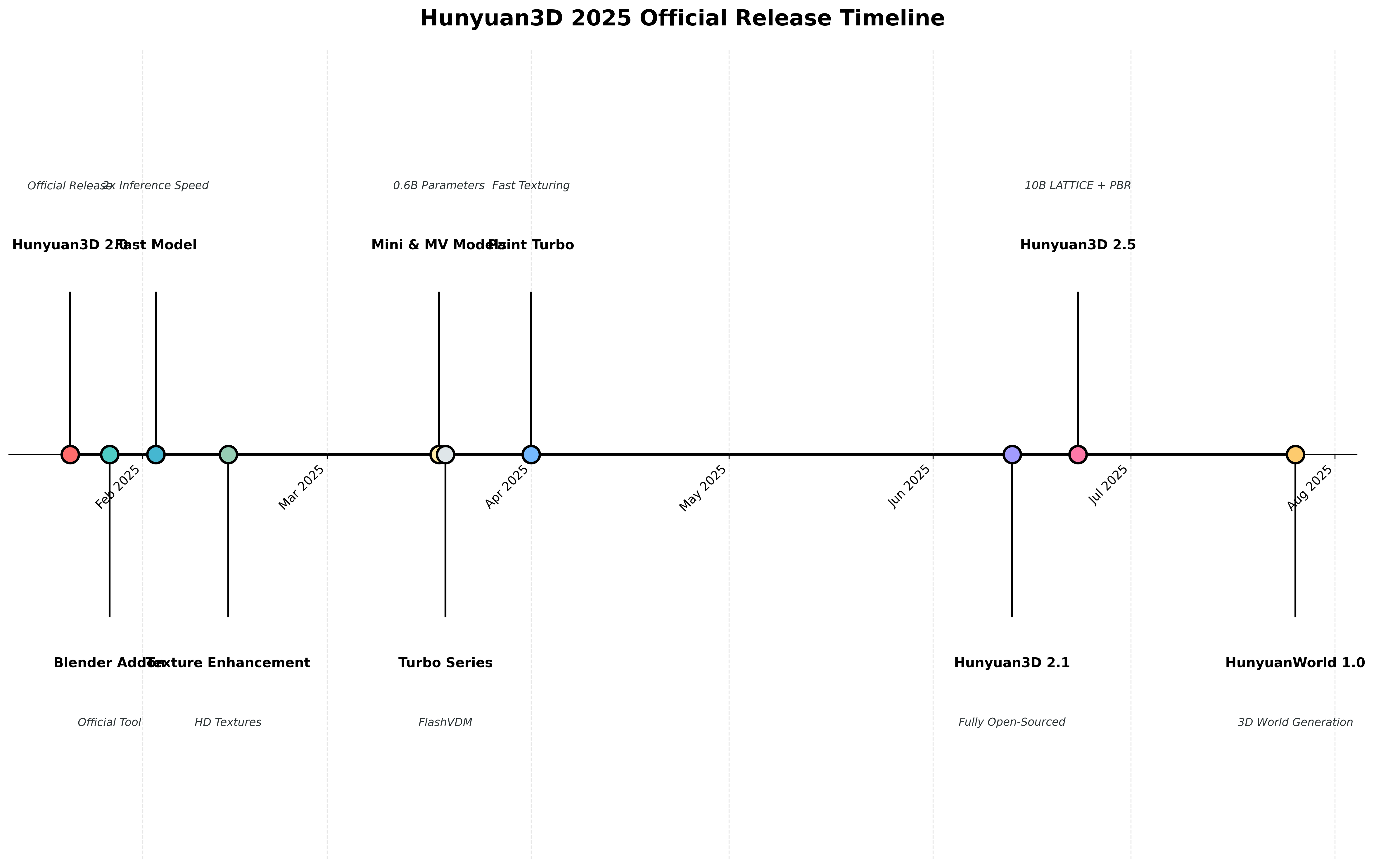 Figure 1: The official release timeline of Hunyuan3D in 2025 (Source: Hunyuan3D Official GitHub Repository [2])
This timeline clearly shows a complete path from model releases and performance optimizations to ecosystem expansion:
-
Early Year (Jan-Mar): Starting with the official release of Hunyuan3D 2.0, the team quickly launched a Blender addon, performance-optimized models (Fast Model, Turbo Series), and a lightweight Mini version, rapidly establishing a foundational toolchain and a multi-layered selection of models.
-
Mid-Year (Apr-Jul): This period was a concentrated burst of technological breakthroughs. The full open-sourcing of Hunyuan3D 2.1 signaled the project’s commitment to openness. Shortly after, the release of the Hunyuan3D 2.5 technical report [1] elevated the model’s technical sophistication to a new level, introducing the 10B-parameter LATTICE model and PBR material generation capabilities to the world for the first time. Finally, the release of HunyuanWorld 1.0 [4] indicated that Hunyuan3D’s ambitions had expanded from generating single “assets” to building vast “worlds.”
This series of verifiable updates not only demonstrates the development team’s strong execution capabilities but also provides a clear context for understanding its technical evolution.
Part 2: A Deep Dive into the Core Technology: From 10B Parameters to PBR Materials
In 2025, Hunyuan3D not only iterated rapidly on its versions but also achieved significant breakthroughs in its core technology. The two main highlights disclosed in the Hunyuan3D 2.5 technical report [1]—the LATTICE model and PBR materials—have collectively pushed the quality of 3D content generation to new heights.
The LATTICE Model: “A Larger Model for a More Detailed World”
“…significantly closing the gap between generated and handcrafted 3D shapes.” — Hunyuan3D 2.5 Technical Report [1]
The LATTICE model is a brand-new shape foundation model introduced in Hunyuan3D 2.5, with its largest scale reaching an astonishing 10 billion (10B) parameters. What does this mean? In simple terms, a larger number of parameters usually means the model can learn more complex and finer features. The goal of LATTICE is precisely to generate 3D shapes with extreme detail while keeping the mesh surface clean and smooth, thereby significantly narrowing the gap between AI-generated models and those handcrafted by human artists.
PBR Materials: “Making the Virtual More Real”
If the LATTICE model builds the exquisite skeleton, then PBR (Physically-Based Rendering) materials breathe a realistic soul into it. Hunyuan3D 2.5 introduced support for PBR materials for the first time, which means that the textures it generates are no longer just “maps” but complex datasets that can simulate how light interacts with different materials (like metal, wood, and fabric) in the real world.
The video below provides a direct look at the enhanced realism that PBR materials bring to 3D models:
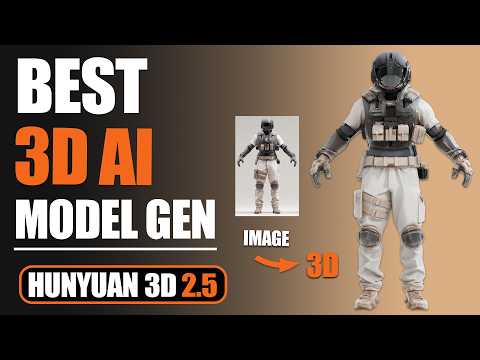 Video 1: A demonstration of the PBR material effects in Hunyuan3D 2.5 (Source: YouTube)
Performance Benchmarks: What Does the Official Data Say?
In addition to generation quality, efficiency is equally important. According to the performance comparison data published in the Hunyuan3D 2.0 technical report [3], we can see its performance across several key metrics.
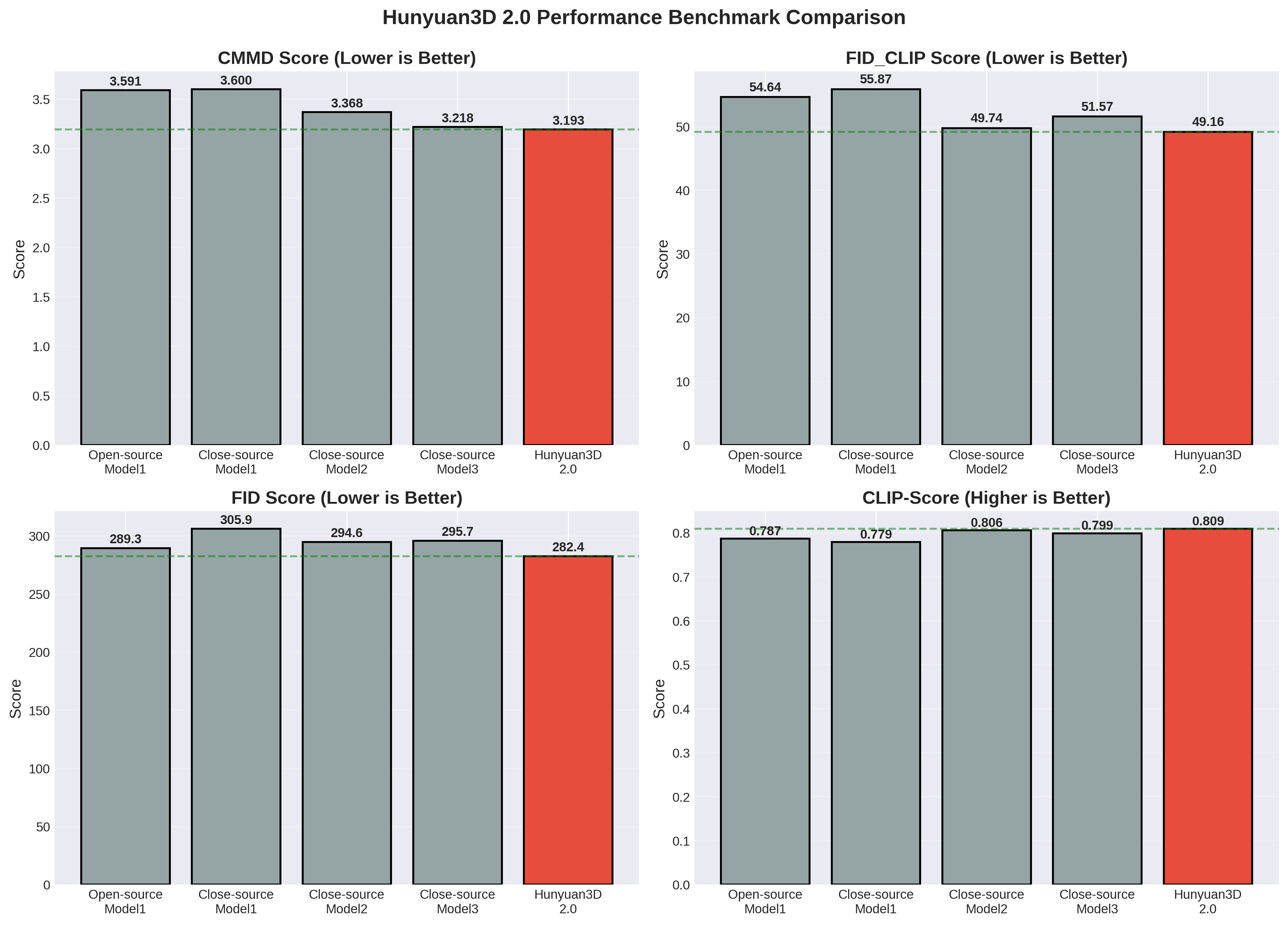 Figure 2: Hunyuan3D 2.0 performance benchmark comparison (Data Source: Hunyuan3D 2.0 Technical Report [3])
The chart shows that Hunyuan3D 2.0 outperformed other leading open-source and closed-source models at the time across all four key metrics: CMMD, FID_CLIP, FID (all lower is better), and CLIP-score (higher is better). This demonstrates its leading position in generation quality and text-image alignment accuracy.
Part 3: Building the Ecosystem: Official Tools and Community Power
The success of Hunyuan3D lies not only in its powerful core technology but also in its open ecosystem and active community. The official team provides a complete toolchain, while the community continuously contributes on top of it, significantly lowering the barrier to entry for users.
The Official Toolchain: Seamless Integration into Your Workflow
- Blender Addon: For the vast community of Blender users, the official
blender_addon.py[2] is a huge boon. It allows users to directly invoke Hunyuan3D’s generation capabilities from within Blender, enabling a seamless workflow from generation to editing. - Docker Image: To simplify the complex environment setup, the official team provides a Docker image [2]. With just a single command, users can quickly deploy a fully functional Hunyuan3D API server locally.
- API Server: The
api_server.py[2] provides developers with a flexible programming interface, making it easy to integrate Hunyuan3D’s capabilities into their own applications or automated processes.
 Video 2: Using the Hunyuan3D addon in Blender (Source: YouTube)
The Shining Community: Making Powerful Tools Simple
The vitality of a project largely depends on the vibrancy of its community. Hunyuan3D has a very active developer community whose contributions have made this powerful tool much more accessible.
- ComfyUI Support: Through projects like
ComfyUI-Hunyuan3DWrapperandComfyUI-3D-Pack, community developers have fully integrated Hunyuan3D into the popular ComfyUI workflow, allowing users unfamiliar with code to use it easily through a node-based interface. - Windows One-Click Installer: For Windows users, community developers have packaged a “one-click installer,” solving the installation difficulties that many users face in a Windows environment.
Watch the video below to learn how to easily install and use Hunyuan3D in ComfyUI:
 Video 3: Installing Hunyuan3D 2.1 in ComfyUI (Source: YouTube)
It is this positive interaction between the official team and the community that has jointly built the thriving ecosystem of Hunyuan3D.
Part 4: From Getting Started to Practical Application: A Collection of Tutorials and Resources
Whether you are a newcomer to 3D AI or a professional seeking efficient tools, the Hunyuan3D community has prepared a clear learning path and a wealth of resources for you.
Your Hunyuan3D Learning Path
Step 1: Quick Experience (5 minutes)
Want to experience the power of Hunyuan3D right away? Visit the Hunyuan3D Online free version to start your first 3D generation creation without any installation.
Step 2: Local Deployment (30 minutes)
Ready to run Hunyuan3D locally? We highly recommend watching the following video, which provides a detailed guide on how to quickly deploy it using Docker. This is currently the easiest and most error-proof installation method.
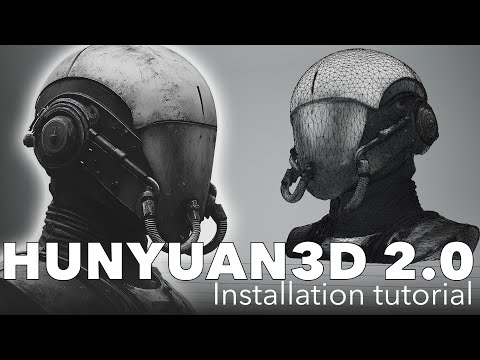 Video 4: A local installation guide for Hunyuan3D 2.0 (Source: YouTube)
Step 3: In-Depth Tutorial (1-2 hours)
Once you have completed the deployment, you can follow the community’s in-depth tutorials to learn how to create a complete 3D character with Hunyuan3D and rig it for animation.
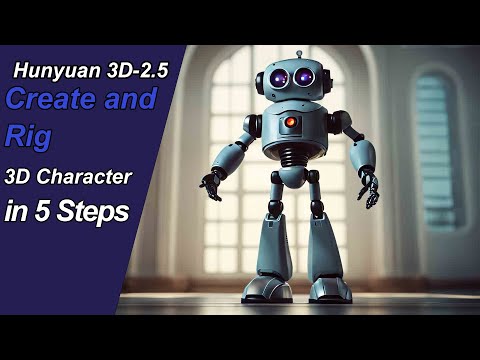 Video 5: Creating and rigging a 3D character with Hunyuan3D 2.5 (Source: YouTube)
Frequently Asked Questions (FAQ)
-
Q: What are the hardware requirements for running Hunyuan3D?
- A: According to the official documentation [2], generating shapes requires at least 6GB of VRAM, while full shape and texture generation requires 16GB of VRAM. The community generally recommends using an NVIDIA RTX 3060 or higher for a smooth experience.
-
Q: Hunyuan3D is not working, how can I troubleshoot?
- A: If you encounter issues, first check the following: 1) Is your GPU driver up to date? 2) Is your CUDA version compatible with PyTorch? 3) Have all dependencies in
requirements.txtbeen installed correctly? If the problem persists, the best place to seek help is the official GitHub Issues page, where the most active developers and community members can assist you.
- A: If you encounter issues, first check the following: 1) Is your GPU driver up to date? 2) Is your CUDA version compatible with PyTorch? 3) Have all dependencies in
Part 5: A Community Outlook for 2026 (Cautious Speculation)
Disclaimer: The following content is reasonable speculation by the community based on currently available public technology. It does not represent the official roadmap and is for discussion and reference purposes only.
Looking to the future is always exciting, but as a community, we should remain rational and restrained. Based on the technological path Hunyuan3D has demonstrated in 2025, we can make some cautious speculations.
The Possibility of Model Accessibility
The LATTICE model in Hunyuan3D 2.5, with its 10 billion parameters, is undoubtedly key to its high-quality detail generation. However, a high parameter count also brings a high hardware barrier. Looking back at March 2025, the official team released a 0.6B-parameter mini version and several Turbo accelerated versions [2]. Therefore, the community widely anticipates that in 2026, we might see lightweight versions of the LATTICE model—such as “LATTICE-mini” or “LATTICE-Turbo”—allowing more users to experience the power of the 10B model on consumer-grade hardware.
From “Assets” to “Worlds”
The release of HunyuanWorld-1.0 [4] in July 2025 was a significant signal, indicating that the team’s vision has expanded from generating single 3D assets to constructing entire 3D worlds. Although Hunyuan3D and HunyuanWorld are currently separate projects, the community is eagerly looking forward to a deeper integration of the two in 2026. Imagine this: you generate a beautiful 3D architectural model with Hunyuan3D and then place it directly into an explorable world generated by HunyuanWorld—what an exciting creative experience that would be!
Conclusion: A Summary of 2025, An Anticipation for 2026
Looking back at 2025, Hunyuan3D has proven its leading position in the 3D AIGC field with its solid technical progress and open community posture. From the full open-sourcing of version 2.0 to the huge leap in model scale and material realism in version 2.5, and the increasingly prosperous community ecosystem, every step has been solid and powerful.
As a community observer, I am genuinely pleased with the achievements of Hunyuan3D over the past year. It has not only provided professionals with powerful productivity tools but has also opened the door to the world of 3D creation for ordinary enthusiasts like myself.
What are your expectations for Hunyuan3D in 2026? Faster generation speeds, lower hardware requirements, or a wider range of application scenarios? Feel free to leave a comment and join our discussion!
References
[1] Lai, Z., et al. (2025). Hunyuan3D 2.5: Towards High-Fidelity 3D Assets Generation with Ultimate Details. arXiv:2506.16504. https://arxiv.org/abs/2506.16504
[2] Tencent-Hunyuan. (2025). Hunyuan3D-2 GitHub Repository. https://github.com/Tencent-Hunyuan/Hunyuan3D-2
[3] Tencent Hunyuan3D Team. (2025). Hunyuan3D 2.0: Scaling Diffusion Models for High Resolution Textured 3D Assets Generation. arXiv:2501.12202. https://arxiv.org/abs/2501.12202
[4] HunyuanWorld Team. (2025). HunyuanWorld 1.0: Generating immersive, explorable, and interactive 3d worlds from words or pixels. arXiv:2507.21809. https://arxiv.org/abs/2507.21809